


Introduction
Smart Money Moves With Structure, Not Emotion
Most traders try to predict the market, Smart Money waits for confirmation.
The Smart Money Concepts (SMC) Strategy flips the retail mindset from guessing to aligning with institutional order flow.
This strategy blends higher-timeframe structure with lower-timeframe confirmation, giving traders a clean, rules-based approach to trading Forex, Indices, and Gold with precision instead of emotion.
By combining the 15-minute chart for directional bias and the 1-minute chart for execution, you can identify where Smart Money is likely operating, and enter at the exact moment price confirms intent.
What Is the Smart Money Concepts (SMC) Strategy?
The SMC Strategy is a multi-timeframe confluence model built on the principles of institutional trading.
✅ Identify directional bias (where Smart Money is likely to push price)
✅ Locate key institutional zones like Order Blocks and Fair Value Gaps
✅ Execute entries with confirmation, not prediction
Instead of reacting to every move, you’re working with structure and liquidity, trading where Smart Money trades, not where retail chases.
Step 1
Frame Your Bias Using 15-Minute Structure
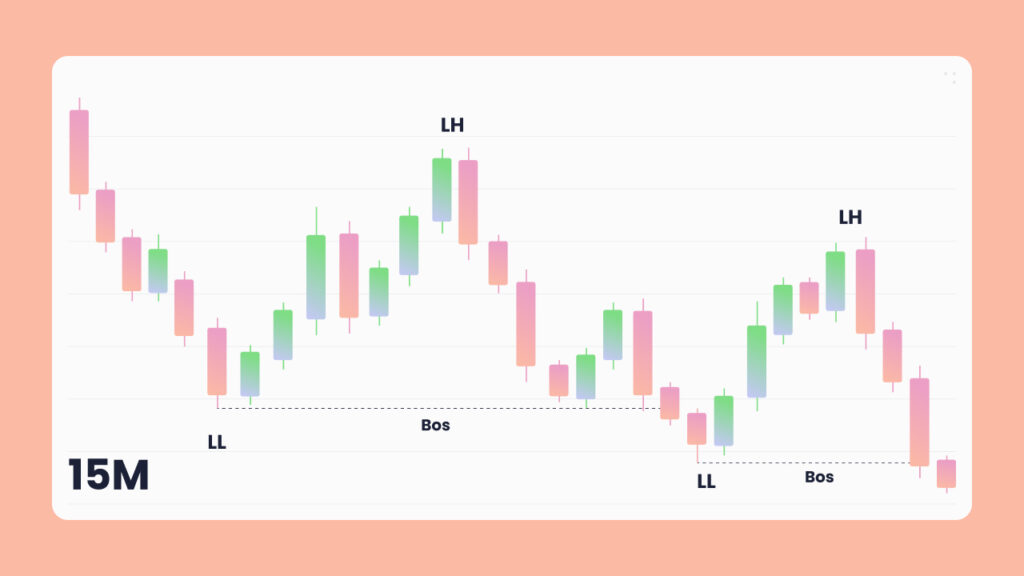
Everything starts with direction.
Open your 15-minute chart and mark the most recent swing high and swing low.
This defines your current trend:
- Bullish Bias: Higher highs and higher lows
- Bearish Bias: Lower highs and lower lows
Once bias is established, identify where price is trading relative to the range:
- Are we in discount (buying zone)?
- Are we in premium (selling zone)?
This gives you your higher-timeframe context, the “story” behind every lower-timeframe move.
Step 2
Locate the Key Order Block
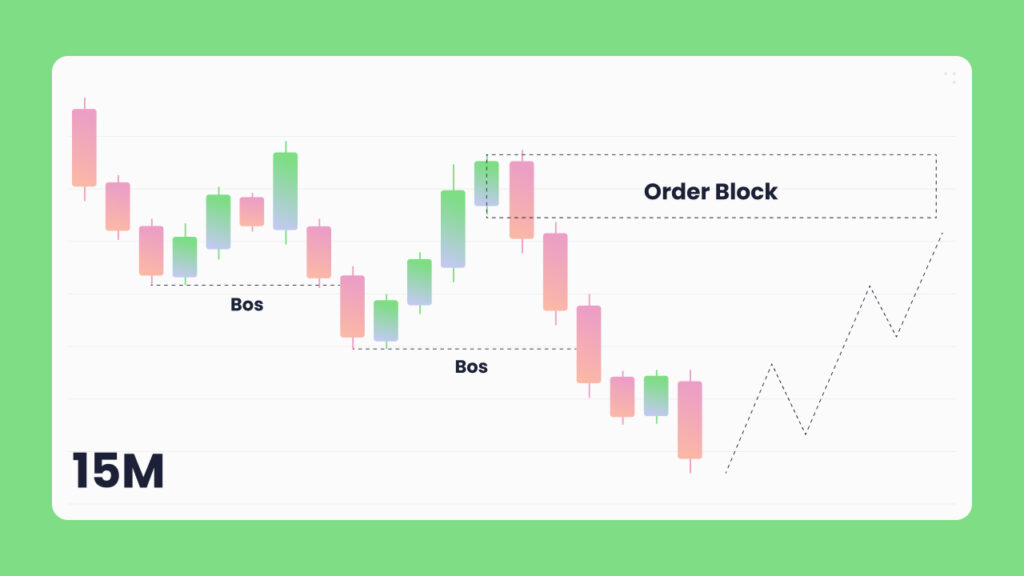
With your bias confirmed, zoom in to find the Order Block (OB) that defines value within that trend.
- In a bullish setup → Mark the last bearish candle before the bullish displacement.
- In a bearish setup → Mark the last bullish candle before the bearish displacement.
This Order Block acts as your institutional footprint, the zone where Smart Money likely entered positions.
Step 3
Locate the Key Order Block
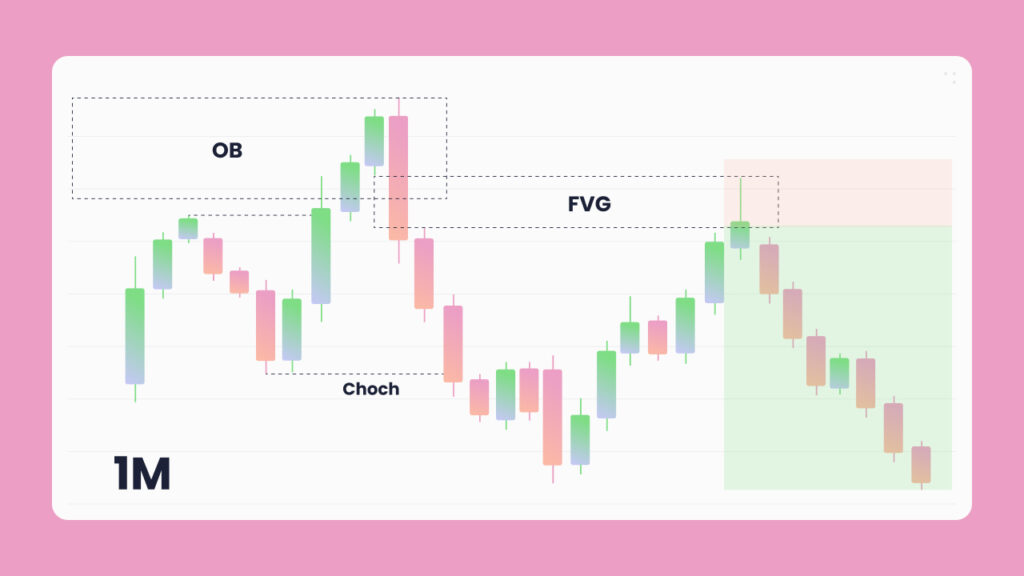
Now, drop down to the 1-minute chart to confirm execution.
When price returns to your higher-timeframe Order Block, you’re looking for confirmation of intent, not blind entry.
Look for one or more of these signals:
- Liquidity Sweep → Price takes out a short-term high/low before reversing.
- Break of Structure (BOS) → A strong shift in structure confirming direction.
- Fair Value Gap (FVG) → A clean inefficiency offering entry precision.
Once confirmation is visible, mark your entry zone and place your stop loss just beyond the manipulation or OB boundary.
Your take-profit target should align with next liquidity levels or a 1:3 RR minimum.
Example
Let’s say you’re analysing XAU/USD (Gold) during the London session:
- On the 15m chart, you notice bullish structure, higher highs and higher lows.
- You identify a bullish Order Block near the 15m discount zone.
- When price retraces, you drop to the 1m chart and wait for confirmation.
- A small liquidity sweep occurs followed by a BOS.
- You enter long from the 1m Fair Value Gap, placing stops below the manipulation low.
This approach keeps you aligned with the macro trend while executing with surgical precision.
Trading Style
Best For: Intraday Traders (London & New York Sessions)
Works On: Forex • Indices • Gold
Confluences: Order Blocks (OBs), Fair Value Gaps (FVGs), Break of Structure (BOS), Liquidity Sweeps
Final Thoughts
The SMC Strategy isn’t about predicting tops or bottoms, it’s about waiting for proof.
By combining timeframes, structure, and confirmation, you transform your trading from emotional to professional.
Remember:
Smart Money doesn’t predict, it reacts with precision.
If your next setup aligns with bias, structure, and confirmation, you’re trading like Smart Money, not against it.
Introduction
Smart Money Moves With Structure, Not Emotion
The SMC Bias-to-Execution Strategy combines higher-timeframe structure with lower-timeframe confirmation for refined, institutional entries.
You establish bias on the 15-minute chart, identify key Order Blocks (OBs) that define value, then drop to the 1-minute chart for precision execution.
This method removes guesswork and keeps trading mechanical, bias first, entry second.
The Core Framework
1. Establish Higher-Timeframe Bias (15-Min)
Identify market direction by observing structure:
- Higher highs/lows = bullish bias
- Lower highs/lows = bearish bias
2. Define Key Order Block
Mark the Order Block that separates premium (sell area) and discount (buy area) zones.
This becomes your value reference.
3. Drop to 1-Minute Chart for Confirmation
Wait for BOS or CHoCH and displacement in the direction of your bias.
Look for FVGs within that shift.
4. Execute on the Retrace
Enter from the FVG or OB on the 1m chart.
Stop at structural invalidation; target 1:3 RR or next liquidity level.
Execution Tips
✅ Bias comes first, never execute against 15m structure.
✅ The 1m entry refines timing, not direction.
✅ Use London and NY sessions for volatility alignment.
Summary
- 15m defines direction.
- OB defines value.
- 1m provides confirmation.
- Execute only after the structure aligns.
Precision comes from process, not prediction.
Introduction
Institutions manage risk by aligning macro structure with micro execution.
This multi-timeframe model replicates that process, identifying bias on the 15m, defining value via OBs, and timing entries on the 1m through displacement and liquidity confirmation.
It’s a controlled, scalable method designed to mirror institutional order flow.
Execution Logic
- Session context refines execution, trade when liquidity is active (London/NY).
- Avoid counter-bias entries; they dilute accuracy.
- Use correlated asset flow or SMT divergence to confirm directional strength.
Principle
Bias defines direction, confirmation defines timing, alignment delivers precision.